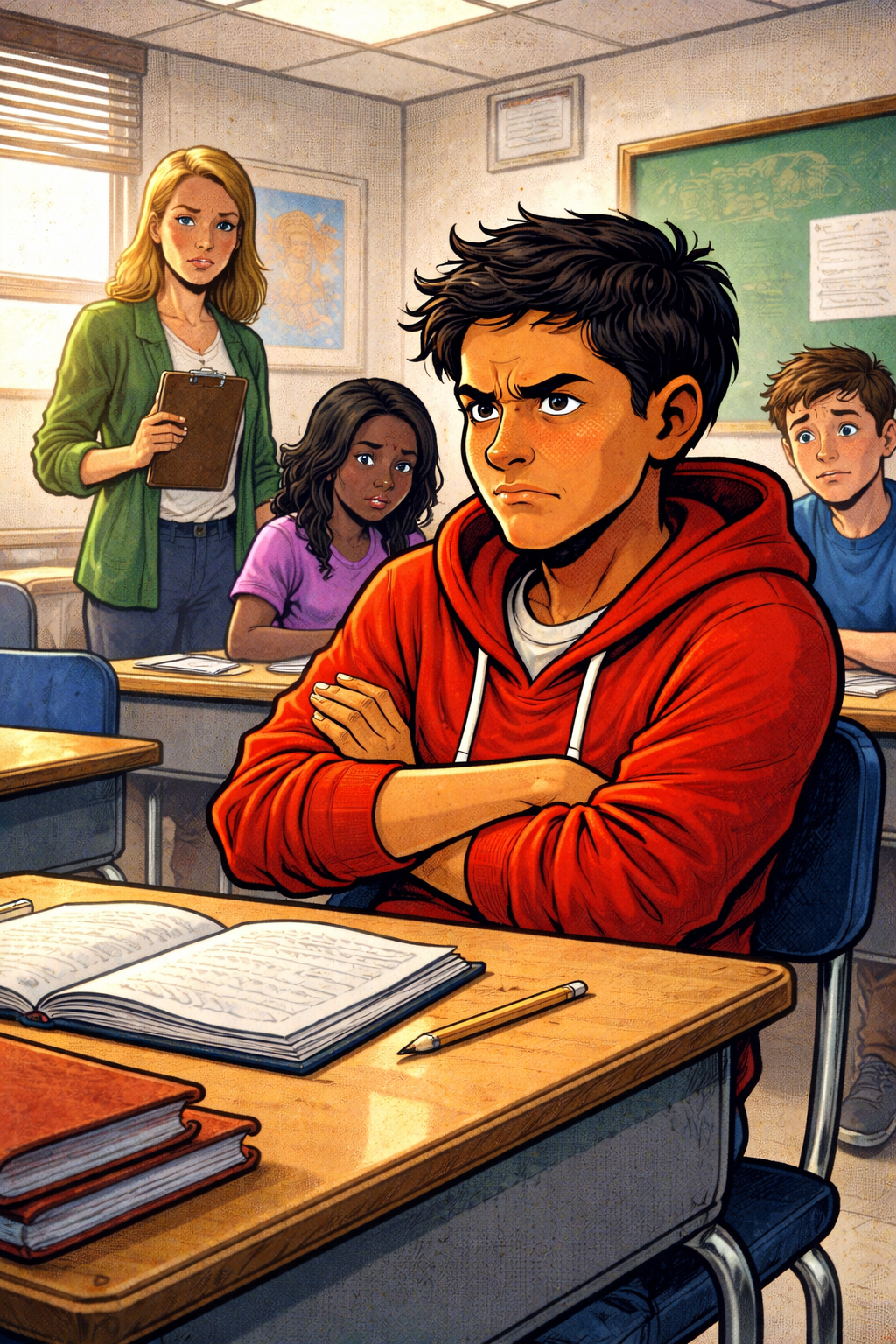
Pretty shocking, I know—but how many times have you felt like your adolescent has done the same?
Maybe not physical violence. But emotional? Mental? Relational? Honestly, all of the above can be on the table during this age of disruption.
Last week, I had a student who did exactly that.
We were in a lesson where students were describing their emotional reactions to lots of different scenarios. One of the prompts was: You see a toddler chasing a cat into a busy street. How do you feel?
They had a long list of emotions to choose from—sad, angry, anxious, scared, happy, joyful, and calm… yes, calm was also an option.
When I asked the class to share their answers, I saw one student shoot his hand into the air. Immediately, I felt that internal warning bell. I knew this probably wasn’t going to go well. But I looked at him. He looked at me. And I had to call on him.
What followed required a truly God-given, Herculean amount of patience.
He read the scenario and said, “I’d feel calm.”
The class froze.
Rage welled up inside me.
The boy smirked.
Low and measured, I said, “Go outside. Immediately.”
Which is not what I wanted to say. I wanted to say several other, far more creative things—but adulting is choosing the sentence that won’t get sent out of the room.
I had my assistant continue the lesson, and I followed him outside. I prayed under my breath. I wanted a hammer—I needed a key. Something that might actually reach him.
And then, like a lightning bolt to the brain, I had it. I knew what to say—but more importantly, what to ask.
“Did you just wake up this morning and decide to choose violence?”
He said, “Yes.”
Well. At least we were being honest.
I told him that was a poor choice. Then he asked, “Can I explain my reasoning behind my answer?”
“Yes,” I said.
His reasoning, when he explained it, was a red herring. A stretch. And not actually answering the question as it was asked. I told him that plainly.
Then I asked him, “Do you really want people to think you’re a jerk?”
He reminded me of a journal prompt he had written earlier in the year about how he sometimes enjoys getting a rise out of people. I told him I remembered.
“But how does that work for you?” I asked. “Do you actually end up enjoying the outcome?”
“No,” he said.
So I asked him a few questions—mostly rhetorical—about his home life, his relationships, and what kind of reputation he was building for himself. Not to shame him, but to paint a clear picture of his choices from a different point of view.
Then I was very clear.
“For the rest of the year, you are no longer allowed to choose violence. Not with teachers. Not with other students. If you do, the hammer will drop.”
We went back inside, both regulated, and continued the day.
And here’s the part that matters: I didn’t hold it over his head.
I called on him again later to answer a question in our vocabulary book. When I asked for help with some grading—a job students usually like to do—I let him help. He had a great rest of the morning.
Right before lunch, he came up to me and apologized. He took responsibility for making a bad choice. And he said he wanted to do better.
That’s adolescence in a nutshell.
Not perfection. Not instant transformation. But a moment of disruption, a moment of correction, and a moment of growth—because an adult stayed regulated and steady, set a boundary, and didn’t hold the past behavior hostage.
I don’t want to give the impression that I reached this level of self-regulation overnight. I can definitely tell you stories from my first years of teaching that would prove otherwise—moments where I reacted very differently, and had to apologize after.
Like most skills worth having, staying calm under pressure was learned the hard way: through mistakes, reflection, and a lot of practice. Growth didn’t come from getting it right every time—it came from noticing when I got it wrong and choosing to do better the next time.
That’s true for adults, too. We’re not modeling perfection for our kids—we’re modeling what it looks like to keep learning.
Adolescence is a season of big feelings, impulsive choices, and testing boundaries. Sometimes it looks like defiance. Sometimes it looks like sarcasm. Sometimes it looks like “choosing violence” before breakfast.
What this moment reminded me of—and what I see again and again in the classroom—
Our job isn’t to eliminate mistakes. It’s to turn mistakes into growth.
What to focus on:
- Stay regulated. Teens borrow our nervous systems. When we stay calm, we give them a chance to find their way back to calm, too.
- Name the behavior without naming the child. “That was a poor choice” lands differently than “You are a problem.”
- Set clear boundaries—and mean them. Limits are not punishments; they are guardrails. Teens actually feel safer when the lines are visible.
- Don’t hold the moment hostage. Correction works best when it’s followed by a clean slate and a chance to do better.
- Leave room for repair. Most teens want to do better once they’ve cooled off and been treated with dignity. Apologies and growth happen when the relationship stays intact.
Being present doesn’t mean rescuing. Being firm doesn’t mean being cold. And being steady doesn’t mean being perfect.
It means showing up, holding the line, and leaving the door open for your teenager to walk back through it.
 Middle and High School Montessori Education
Leave a comment