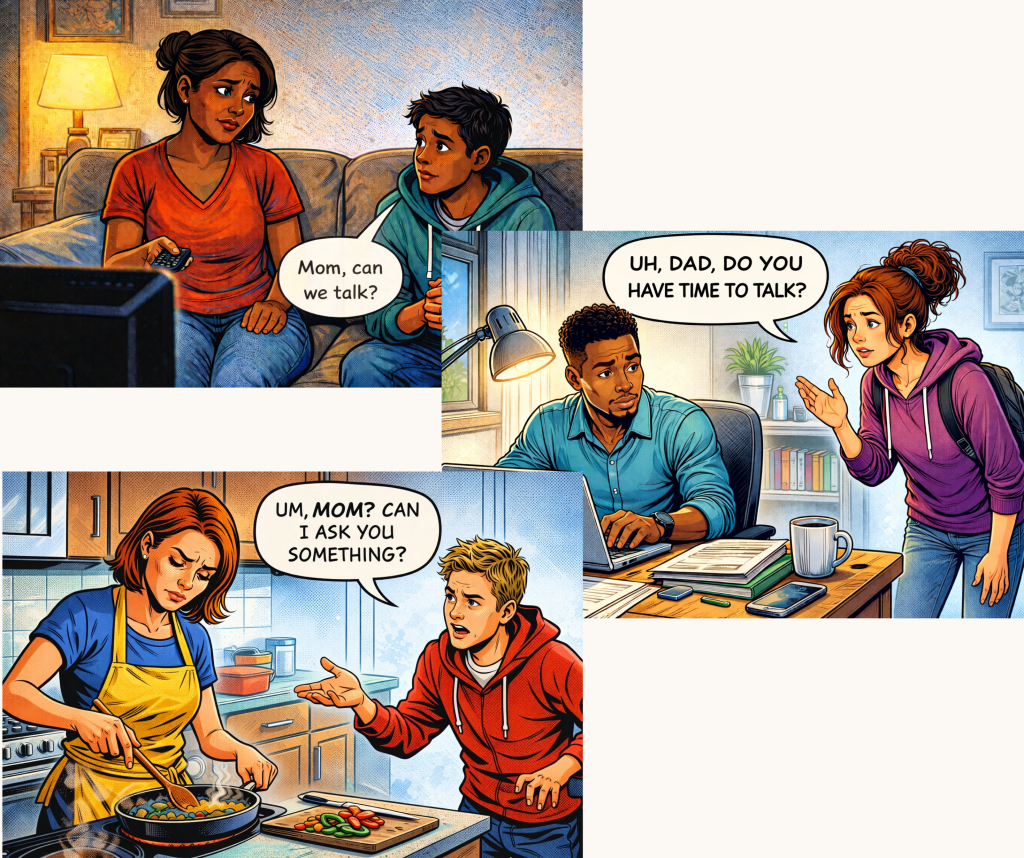
How often does your teenager ask you questions? And not just the “what’s for dinner?” kind, but the kind that open the door to real, meaningful conversations—the ones where you get a glimpse of their heart?
That often, huh? It can be hard to have deeper level converstions with teenagers. They feel like different people or strangers even, from the little children they once were.
Most adults think that once their child reaches adolescence, they don’t need their parents anymore. But really, nothing could be further from the truth.
Teenagers may not need you like a newborn or a toddler does—but in many ways, they are social newborns. They don’t know how to read social cues, or how to say what they are thinking in a kind way. They are learning how to exist in a bigger, more complicated world; figuring out friendships, identity, boundaries, failure, independence, and responsibility all at once. They have a different set of needs, and need a different kind of care.
Instead of needing you to hold the bottle, they need you to hold space. Instead of needing you to carry them, they need you to walk beside them. Instead of needing constant supervision, they need a non-emotional steady presence, wise boundaries, and adults who won’t disappear just because they look more grown.
Adolescence isn’t the season to step back—it’s the season to show up differently.
Meeting those needs means recognizing that relationship-building isn’t efficient. It can’t be optimized or neatly scheduled. It asks for flexibility, presence, and a willingness to be interrupted.
When a baby cries in the middle of the night, we don’t accuse them of poor timing. We understand that need doesn’t arrive on a convenient schedule. Teenagers aren’t so different, but instead of cries, they bring questions. Instead of midnight feedings, they bring late-night conversations, hallway confessions, and half-formed worries they’re finally brave enough to say out loud.
Being there doesn’t mean rescuing, (but we’ll talk about that more in another blog) it means making time when your adolescent is finally ready.
Real relationships with teenagers don’t live on calendars and timelines.
They don’t schedule their brave moments. They don’t book an appointment for vulnerability. They ask their biggest questions while you’re unloading the dishwasher, answering one last email, or finally sitting down after a long day. They test the water with a half-sentence. They circle the room. They say, “Never mind,” when they think they’ve missed their window.
Allowing your time to be interrupted is not the same as having unlimited time. It’s choosing to treat certain moments as more important than your plan. It’s recognizing that some interruptions aren’t obstacles to your life—they are your life.
When a teenager interrupts you, what they’re really doing is taking a risk. They’re saying, without quite knowing how to say it, “Are you safe right now? Are you available? Is this a good moment to be real?” If the answer feels like no too many times in a row, eventually they stop asking.
And the loss is quiet.
Not dramatic. Not obvious. Just fewer doorframe conversations. Fewer half-formed thoughts spoken out loud. Fewer chances to see who they’re becoming.
Being interruptible doesn’t mean dropping everything for every small thing. It means learning to recognize the rare and fragile moments when your teenager is reaching for you. It means putting the phone away, pausing the show, letting the to do list wait. Saying, “Yeah, I’e got time, tell me,” and meaning it.
From the classroom, I see how powerful it is when a teenager believes an adult will make room for them. From the outside, I can tell you this: time is what tells a teenager they matter. Not grand gestures. Not lectures. Time.
The truth is, most of what shapes a relationship isn’t planned. It happens in the margins. In the interruptions. In the unscheduled moments that turn into memories.
So maybe the question isn’t, “Do I have time?”
Maybe it’s, “Am I willing to let my time be interrupted for the things that matter most?”
 Middle and High School Montessori Education
Leave a comment